Friday, 31 August 2012

Rowan Berries


Rowan Berries : Acrylic paints,beads and stitching on linen (75cm x 60cm).


Detail


Detail : photos (above) by owner.


Rowan Berries.


Rowan trees in a Community Woodland.


Self seeded trees growing among heather in a Perthshire Glen.


For centuries Rowan Trees have been planted in gardens as symbols of good luck.

The semi-circular mound in the background is the remains of Fendoch Roman Fort 
dating from around  90 A.D.


Wednesday, 22 August 2012

The Old Drove Road


River Tweed at the village of Yael near Galashiels,Scottish Borders.

Driving around country roads in this area,looking for a woodland walk,my friend Morelle and I found a ramblers route leading to the hills.The path we took is part of the Southern Upland Way,which traverses southern Scotland. Before the days of railways this was a drove road used by drovers to move cattle to markets across the country.


The Tweed is a well known salmon fishing river.


We walked along a road beside the river before taking the path to the hills.


Roadside vegetation.


Southern Upland Way


Birch Trees


Dry stone wall


Hay field


Conifer plantations


Scottish Bluebells  (Harebells)

In folklore they are linked with magic and called witches thimbles and fairy bells.


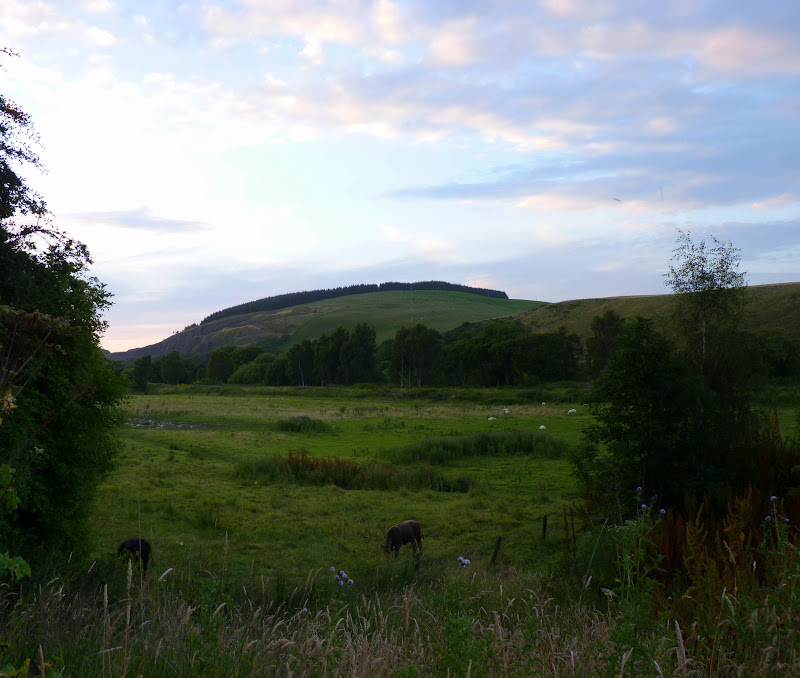
Fields at dusk.

The tree lined rounded hilltops define the landscape of this area.


Feathers,petals and rowan berries collected in my garden.


Wednesday, 15 August 2012

Phoebe Anna Traquair Murals


Phoebe Anna Traquair was born in Dublin in 1852 and died in Edinburgh in 1936. As a young woman she studied art at the Royal Dublin Society,later moving to Edinburgh with her Scottish palaeontologist husband Dr. Ramsay Heatley Traquair,with whom she had three children.

  She is remembered as one of the prominent artists in the Scottish Arts and Crafts movement. A painter illustrator,embroiderer and enammeller,in 1904 examples of her work were exhibited at the World's Fair in St Louis. Byzantine,Pre-Raphaelite and Italian Renaissance art were sources of inspiration for her work.

Towards the end of the 19th century Phoebe was commissioned to paint these murals in the recently built Catholic Apostolic Church in Edinburgh's Neo-Classical New Town.This massive undertaking took her eight years,working on scaffolding and only when the light was good. 

Central to the beliefs of the Catholic Apostolics was the expectation of the imminent Second Coming of Christ. The atmosphere in the church was one of joyful celebration. Services contained elaborate ritual,processions,rich vestments,incense,spiritually uplifting music and singing.


After the Catholic Apostolic congregation moved out in 1958 the building fell into a state of disrepair eventually facing possible demolition. In the 1990s a group of concerned people set up a Friends organisation with the objective of rescuing and restoring the building and the murals. What you see here is the result of a massive interior and exterior restoration project.

The building now functions as the Mansfield Traquair Centre.   


This ceiling depicting the Tree of Life was partly designed by Pheobe but not painted by her.


 The baldacchino designed by the architect of the building.

This is really beautiful,like an elaborately decorated cake.


Rounded arches characteristic of the Romanesque style.


At the Second Coming of Christ an angel is assigned to each soul to assist them on their journey.


The former church,designed in the Neo- Romanesque style by architect Sir Robert Rowland Anderson
 was completed in 1885.


The buildings opposite are part of the city centre New Town development dating from around 1800.


The termination of the nave is of semi-circular design,common in Romanesque architecture.


Related Posts Plugin for WordPress, Blogger...